Have you heard of the Commodore 64? Here’s Why this Retro Tech Classic Still Matters
Let’s rewind to December 25th, 1985.
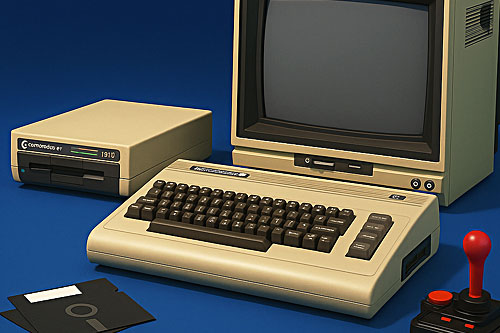
I’m 13 years old, kneeling in front of the family Christmas tree in sweatpants with a cowlick that just won’t quit. And there they are: a couple of large boxes wrapped by Santa’s elves with none other than yours truly’s, name on them. Inside? The Commodore 64. Complete with a 1541 disk drive, monitor, joystick, and a dot matrix printer that sounded like it was eating gravel every time it ran. Priceless I know.
I swear to this day—I heard angels sing.
That machine didn’t just change my life. It literally launched it. Welcome come the big leagues Steven. Your life has now began.
Fast forward 40 years: we’re now decades deep into a world of iPhones, ChatGPT, foldable OLED screens, 3D-printed burritos. with Tesla Bots right around the corner. And yet… retro tech like the Commodore 64, a mere 8 bits, still matters. I mean how is this even possible. It’s not because it’s useful in the modern sense (let’s face it, it’s not running your TikTok feed), but because it teaches us something that all the shiny new stuff tends to forget.
Why the C64 Won’t Go Away: Getting to the Bottom of It
Simplicity was a feature, not a bug.
With 64KB of RAM (yes, you read that right), the Commodore 64 forced you to think lean. You couldn’t just code bloat your way through a problem. You had to solve it quite efficiently.
There were no distractions. No Slack or text notifications. No “auto-save to the cloud.” You wanted to write a game? You had to learn BASIC. You wanted to hack around with sprites? You had to understand memory mapping.
Today’s tools are miraculous when ccompared to teh C64, sure, I give you that. But they often hide the “why” behind layers of abstraction and distraction. The C64 didn’t hide a thing. It said: “Here’s your toolbox. Now go build something that matters to you. We dare you to make the world more enjoyable.”
Retro Truth Bombs: Sales and Legacy
In its early days, the C64 launched quietly in 1982. Initial sales were modest—around 360,000 units that first year—as Commodore grappled with early reliability issues (doesn’t all tech), limited software, and hardware supply constraints. However, the tide began to turn in 1983, when approximately 1.3 million units found their way into homes. That year marked the end of its start up phase, which was fueled by aggressive pricing (including cash rebates and console-trade promotions), broader retail distribution, and an expanding software library. The Commodore 64 was prime for world domination.
In 1984, its sales leaped to an impressive 2.6 million units— and proved to be its best single-year performance. Between 1983 and 1986, the C64 averaged about 2 million units per year, capturing 30–40% of the U.S. home-computer market while surpassing major competitors like Apple, IBM compatibles, and Atari.
That peak year of 1984 marked the zenith of the Commodore 64’s sales trajectory—establishing it as the highest-selling single computer model ever, eventually reaching a total of 12.5 to 17 million units over its lifetime.
Sales estmates vary. However, it is worth noting that the The Guinness Book of World Records claime “the C64 is the best selling single computer model of all time with sales of about 30 million units between 1982 and 1993.”
Sales Claims: Total Estimated Units Sold
| Source / Method | Estimated Units Sold |
|---|---|
| Commodore official (1993 Annual Report) | 17 million |
| Serial-number analysis (Michael Steil, 2011) | ~12.5 million |
| Guinness / Jack Tramiel claims | 22–30 million |
| Modern meta-analysis (including C128) | 20+ million |
The fact that we’re still debating its actual sales numbers shows how impactful this thing really was. Whether it was 12 million or 30 million, it clearly sold in numbers that kept Silicon Valley up late at night.
C64 vs. Its Contemporaries
| Platform | Estimated Units Sold |
|---|---|
| Commodore 64 | 17 million |
| Nintendo Entertainment System (NES) | ~60 million |
| Sega Master System | ~10–13 million |
| ZX Spectrum | ~5 million |
| Apple II | ~5 million |
While the NES dominated the living room with controllers and cartridges, the C64 quietly turned garages into coding laboratories.
Voices from the Retro Trenches
“We made machines for the masses… They [Apple] made machines for the classes.” — Jack Tramiel
Tramiel’s ethos was real—focus on accessibility, not exclusivity.
“The SID … the quality of the sound has to be heard to be believed.” — BYTE magazine, July 1983
That quote reminds us that C64 wasn’t just affordable—it was high-quality tech, even compared to pricier alternatives.
“Because it’s an old friend,” says Robert Bernardo, president of the Fresno Commodore User Group, about sticking with his C64.
That sums up the bond: not just tech, but loyalty—and a refusal to jump ship.
“The buzz that was around at the time was that musicians are gonna have to get into computers.” — Rob Hubbard
Even composers saw the C64 as more than a mere child’s toy—it was a creative engine, a musical lab of sorts.
Tech Spotlight
You could own your technology. Imagine that.
No subscriptions. No DRM. No mystery meat UI updates that rearrange your settings overnight. When you bought a C64, it was yours.
You could pop it open, solder in extra ports, copy disks for friends (okay maybe not legally, but from what I hear it was possible to do it if one wanted to. You learned how it worked. It was up to push the boundaries. They were there to be pushed, not license-locked. No jail breaking required
Today, it feels like we rent everything—our music, our movies, even our operating systems. Retro tech? That was a love letter to personal freedom.
10 Modern Uses of the Commodore 64
- Retro Gaming Console
Used to play classic games via original media or SD card adapters. - Demoscene Productions
Artists and coders create visual and musical demos that push the C64’s limits. - Chiptune Music Creation
The iconic SID chip is still used to compose 8-bit electronic music. - Programming Education
A great tool for teaching BASIC and assembly in a distraction-free setup. - Modern Hardware Mods
Add-ons like Wi-Fi cartridges and HDMI adapters bring the C64 up to speed. - Media Centers & Servers
With clever mods, some use the C64 as basic web or file servers. - Art Projects
Artists use the C64’s graphical limits to create stylized pixel art. - Twitch/YouTube Content
Popular for retro gaming streams, repairs, and programming tutorials. - Emulation Stations
TheC64 Mini and full-size versions bring the experience to modern setups. - Collector Showpieces
Restored or modded C64s are prized in tech museums and personal collections.
Would I Buy It Again?
Absolutely. In spirit, if not in plastic.
Look, I don’t want to go back to the days of waiting 20 minutes for a game to load off a cassette. But I do miss the curiosity those machines sparked. They weren’t tools; they were invitations. Every line of code felt like a mini-victory. Every crash was a lesson. You weren’t just a user. You were an explorer. A creator!
And that’s something we should keep alive—even now, in the age of smart fridges, cars that talk, and iPhones.
Tech Tip: Using the C64 Today
Try emulating retro systems—legally. It’s easier than you think.
There are Commodore 64 emulators (like VICE) that run on modern machines. Pair it with a retro game archive or dabble in old-school programming. You’ll be surprised what coding in a constrained environment teaches you about today’s bloated tech stacks.
So next time someone chuckles at your old tech collection or asks why you still keep that beige box in the basement, tell them this:
It’s not about the hardware. It’s about the mindset it gave us. One of curiosity, creativity, and control.
And always remember friends… just because it’s new doesn’t mean it’s better! til’ next time.